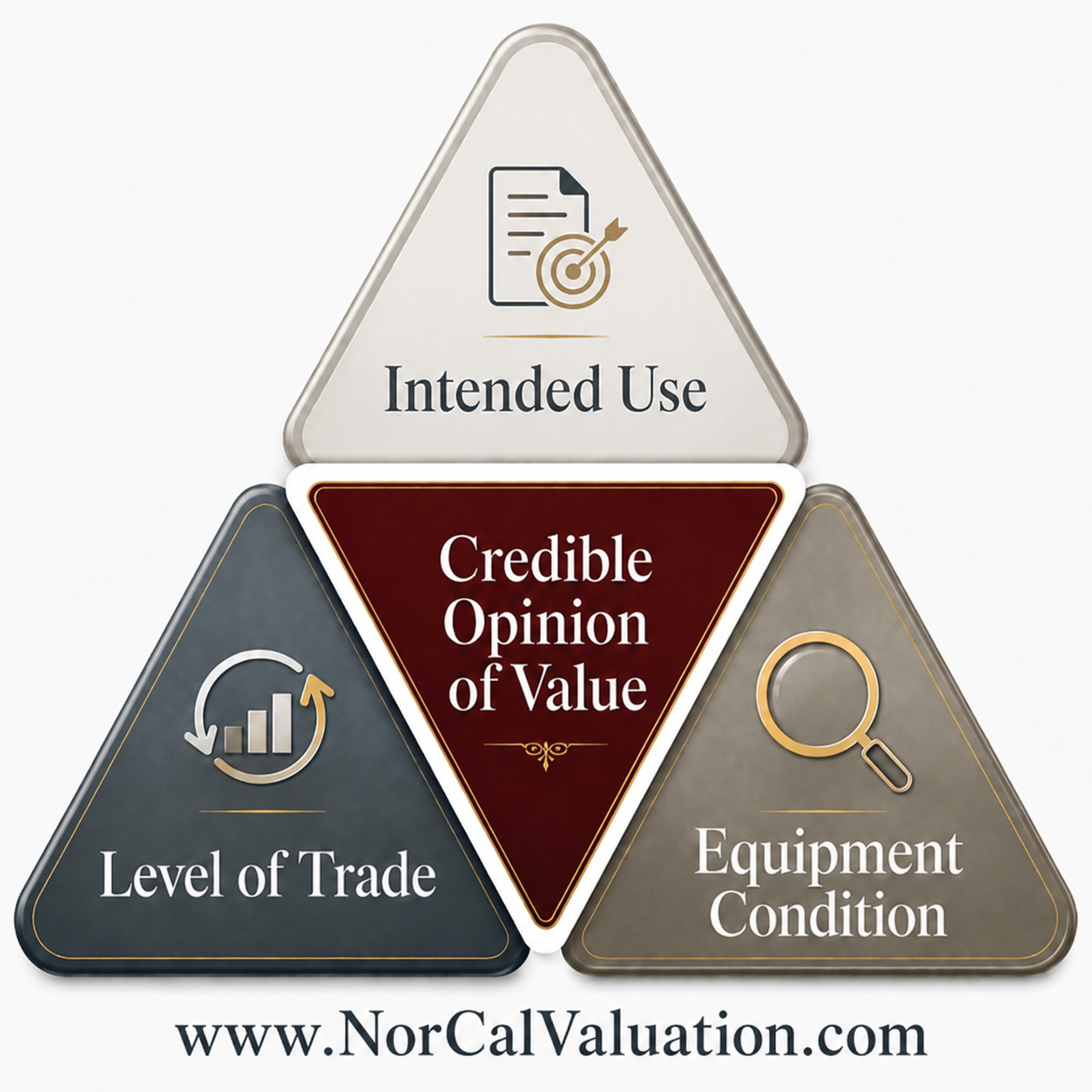
 The value comes at the end of an equipment appraisal, not the beginning
A car wash equipment appraisal determines the value of the machinery and equipment; not necessarily the land, building, or operating business. The value depends on the specific equipment, its condition and effective age, the purpose of the appraisal, the applicable definition of value, and evidence from the relevant market. Original cost and accounting depreciation alone do not establish equipment value.
As a car wash owner, you may sometimes wonder: What is it worth? To you and your business partners, this may seem like a perfectly reasonable question, right? Especially if you are considering a business loan or a buy/sell situation. But as an equipment appraiser, I’d have to tell you—it’s not as simple as it may seem. A car wash facility presents an interesting and complex appraisal problem: There’s the land, the building, the operating business, customer relationships and goodwill, and then there is the machinery and equipment: pumps, motors, brushes, vacuums, compressors, payment systems, water-treatment equipment, controls, sensors, dryers, chemical-delivery systems, and the other machinery that make cars cleaner than they went in.
Those assets may all occupy the same property, but they are not the same asset, and the distinction matters when an appraisal is being prepared for a tax matter, financing, a purchase or sale, litigation, estate planning, or another business use.
I was reminded of this recently at an inspection of a California car wash as part of a machinery and equipment appraisal for an estate. A car wash may look like one operating facility, but from an equipment appraisal standpoint it is a collection of assets with different manufacturers, models, ages, conditions, maintenance histories, and markets. A twenty-year-old car wash may contain a ten-year-old rollover system, five-year-old payment equipment, recently rebuilt pumps, aging vacuums, and newly replaced controls, so saying “the car wash is twenty years old” does not tell me very much about what the equipment is worth. Neither does saying the equipment has been fully depreciated.
What value is not
One of the first documents offered in the appraisal process is the owner’s fixed-asset list. It can help identify what equipment the business owns and may provide acquisition dates, original costs, asset descriptions, and other information that can be matched to the machinery being appraised. A depreciation schedule may provide some of the same historical cost information, accumulated depreciation, and book value, but neither document states what a machine is worth.
Fully depreciated is an accounting fact, not a valuation conclusion
The American Society of Appraisers’ machinery and equipment textbook distinguishes accounting depreciation from appraisal depreciation. Most business owners are familiar with accounting depreciation, which is primarily concerned with allocating or recovering an asset’s cost over time.
Appraisal depreciation, on the other hand, concerns loss in value and may reflect physical deterioration, functional obsolescence, and economic obsolescence. That distinction matters because a water-softening system can reach zero book value and still operate reliably, have useful remaining life, and have buyers willing to pay for it. California property-tax guidance makes much the same point: equipment may be fully depreciated for accounting or income-tax reporting and still possess value for property tax.[1] The reverse can also happen: equipment can carry substantial book value while changes in technology, condition, demand, or the marketplace support a considerably lower value.
Beware, too, of using the stated age of the carwash facility to shortcut the analysis. Two car wash facilities may each have a five-year-old commercial air compressor from the same manufacturer with similar capacity, yet one may have been lightly used, regularly serviced, and recently rebuilt while the other ran continuously in difficult conditions with only emergency repairs. ASA uses the concept of effective age to address this issue. Effective age reflects the apparent age indicated by an asset’s actual condition relative to new property of like kind, taking into account overhauls, rebuilds, and above- or below-average maintenance. Chronological age matters, but so do condition, usage, maintenance, rebuilding, and remaining utility. That is why an equipment appraisal cannot simply be reduced to Original Cost × Age Percentage = Value. It might seem a simple solution to the value question, but it’s probably not going to produce a credible answer.
Cost is useful. But cost is not value.
A fixed-asset list often also includes the cost of the equipment when purchased. This can be useful information for equipment appraisals using the cost approach, but cost is not value.
Cost approach is one of the three traditional methodologies of appraisal practice and we’ll talk about it, along with the other two approaches, later in this article. For now, just be aware that while the cost approach to value may sometimes seem like a simple solution to the appraisal question, cost approach calculations without appropriate analysis and understanding is just another way to produce an unreliable valuation conclusion.
What is being valued?
Before valuation analysis begins, the appraiser needs to identify all the equipment associated with the carwash facility.
USPAP uses the term personal inspection for an appraiser’s in-person observation of the subject property when that observation is part of the scope of work. USPAP does not require a personal inspection in every assignment. Advisory Opinion 2 explains that deciding whether an inspection is needed, and how extensive an agreed-upon inspection should be, is a scope-of-work decision made by the appraiser in consultation with the appraisal client.[2] But whether the carwash will be personally inspected or not, Standards Rule 7-2 does requires identification of property characteristics relevant to the type and definition of value and intended use, including condition, size, quality, manufacturer, age, alterations, restorations, and obsolescence.[3]
Whether or not I’ll be performing a personal inspection, I still need to collect and organize data for each asset. We always assign individual reference numbers to significant assets or groups of equipment, so photographs, field notes, research, and valuation calculations can all be connected to the same property. For a recent car wash facility appraisal, for example, asset reference number N-101 was assigned to the Ryko Automatic Rollover Wash System, with associated fields for manufacturer, model, serial number, age, capacity, and observed condition, as suggested by ASA’s Machinery and Equipment Committee in Valuing Machinery and Equipment. Our spreadsheet—which also contains fields for notes on configuration, attachments, controls, repair or rebuild history, reported operating status, and other characteristics relevant to the assignment—supports the appraisal standard of care that ASA and USPAP require.
There is a practical reason for each of these fields, and all this information: a car wash does not age as a single unit. Components are replaced, rebuilt, upgraded, removed, and added over time. The payment system may be much newer than the wash equipment, the controls may have been replaced recently, and the pumps may have been rebuilt several times. The facility has one street address, but its equipment does not have one economic age.
Why? The critical appraisal question
A common misunderstand is that telling your appraiser “I need an appraisal for a tax matter” is enough information. It’s not. There are many different tax related situations, all of which have their own considerations. Appealing California business personal property, income-tax reporting, an estate or gift, a charitable contribution, and the many business transactions with their specific tax consequences will all present different valuation questions. That’s why ASA’s Valuing Machinery & Equipment emphasizes the importance of establishing the appropriate definition of value for all assignments, including tax-related one. And that’s also why an appraiser will want to establish communication with the client’s CPA, attorney, or other tax advisor early in the appraisal process. The equipment appraiser’s role is valuation, not tax or legal advice, and clearly understanding the valuation question is a critical part of answering it credibly.
For California business personal property, for example, the State Board of Equalization states that business personal property and fixtures are valued annually as of the January 1 lien date. County assessors generally begin with reported historical cost and apply applicable cost and depreciation factors in developing an estimate of fair market value.[4] An appraisal for financing, litigation, an ownership dispute, estate planning, insurance, or a sale may present a different problem, and of course the valuation question established the relevant market.
Relevant Market for Intended Use
Imagine that my market research for the carwash appraisal used as an example earlier, turns up a used Ryko wash system advertised online. It may be useful market evidence, but not simply because it is a Ryko. Its usefulness will depend. Is this just an asking price or was there a completed sale? If a sale, was it was an auction sale, dealer offering, liquidation, or arm’s-length end-user transaction? I’ll also need to know the system’s condition, capacity, effective age, configuration, included accessories, and transaction date.
USPAP requires the appraiser, when necessary for credible assignment results, to analyze current and viable alternative uses, define and analyze the appropriate market, recognize relevant market levels, and consider relevant economic conditions as of the effective date.[5] ASA likewise emphasizes that sales-comparison adjustments should reflect meaningful differences between the subject and the market evidence. In other words, the market comes before the comparable; an asking price floating around the internet is not automatically market evidence relevant to the appraisal.
Where? The question of real estate
Car washes become especially interesting when the economics of the equipment and the economics of the real estate begin moving in different directions. Imagine a long-established car wash in the San Francisco Bay Area. The machinery works, customers still come, and the business is profitable, but the land underneath the operation has become extremely valuable because zoning, redevelopment activity, housing demand, density allowances, or other market conditions support a more intensive use – perhaps multifamily housing. That does not suddenly make the equipment worthless, but it may change the valuation problem.
Valuing Machinery & Equipment discusses Highest and Best Use and notes that it can influence the selection of the appropriate premise of value. USPAP approaches personal property somewhat differently, requiring analysis of current and viable alternative uses when such analysis is necessary for credible assignment results. [5] If I am appraising only the machinery and equipment, I am not automatically offering an opinion that the Highest and Best Use of the underlying real estate is apartments; that is generally a real-property valuation issue. But the real-estate situation may lead to an important equipment appraisal question: Would market participants expect this equipment to remain installed and operating at this location?
If the evidence supports continued operation, an ASA premise such as fair market value–installed may be relevant, depending on the assignment. ASA describes fair market value–installed as the value of an installed asset based on market conditions for that asset, independently of the earnings generated by the business in which it is installed.[6]
Now, what if reliable evidence indicates the parcel has been sold for redevelopment and the car wash will close? The machinery has not changed, but the questions have: What will dismantling and removal cost? Can the machinery be economically installed elsewhere? How much useful life remains? Is there an active secondary market? Has newer technology reduced demand? Under some assignment conditions, fair market value–removed may now be the more appropriate definition of value. [7] The equipment did not physically change overnight; its economic context did.
Even in a continuing operation scenario, it’s important to choose the value definition carefully. Valuing Machinery & Equipment differentiates between fair market value–installed and fair market value in continued use and a discerning equipment appraiser will do the same, while also carefully distinguishing between continued use with assumed earnings and continued use with an earnings analysis.[8]
Choosing the most appropriate definition of value terminology describes different analytical assumptions and valuation questions, so when we consider the various situations for which a client may need a valuation of a car wash, we start to better understand that assuming the appraisal of every operating car wash appraisal will be a “continued-use appraisal” could lead to an indefensible value opinion.
How? Choosing an approach to value
USPAP presents three recognized approaches to value: the cost approach, sales comparison approach, and income approach. USPAP does not stipulate which of the three be used for an assignment. Instead, Standards Rule 7-4 requires that appraisers “collect, verify, and analyze all information necessary for credible assignment results.”[9] In practice, machinery and equipment appraisers generally base their credible assignment results upon the sales comparison or the cost approach; when necessary for credible results, they may use both and reconcile to support a final opinion of value.
While the income approach is rarely used in equipment appraisal, a carwash owner may request this approach since an operating car wash generates revenue. Here’s how we explain to clients why it’s not an appropriate approach: all the revenue does not belong entirely to the machinery, as required for the income approach. Carwash income reflects the combined contribution of the real estate, location, building improvements, equipment, employees, management, customer relationships, business name, goodwill, and other tangible and intangible assets. Simply capitalizing the entire income stream and calling the result equipment value would not accurately answer the a pertinent appraisal question.
Under the sales comparison approach, the appraiser looks to relevant secondary-market evidence, where effective age, condition, capacity, location, configuration, sale circumstances, timing, and market level may all matter.
Under the cost approach, the appraiser may ask what equivalent utility would cost today and then analyze physical deterioration, functional obsolescence, and economic obsolescence. This is sometimes the only way to get a valid and supportable value for complex or custom equipment or equipment assemblages, such as a carwash facility, so let’s discuss it a little more.
Cost approach for car wash appraisals
Cost approach is based on the premise that a knowledgeable buyer will not pay more for an asset than the cost to produce a substitute asset with the same utility as the subject. So an early question to be answered in a cost approach appraisal is “What would a substitute asset cost?”
Two different and important cost-approach concepts are Replacement Cost New and Reproduction Cost New, both inconveniently abbreviated as RCN in some appraisal literature, so you’ll want your appraisal report narrative to clearly state which concept is being used in the cost approach.
Replacement Cost New, which ASA describes as the current cost of similar new property having the nearest equivalent utility to the property being appraised. With this approach, appraisers may research what comparable new equipment costs today, drawing on manufacturers, dealers, published cost sources, installation information, freight, electrical and plumbing requirements, controls, accessories, engineering, and other expenses associated with putting machinery into service.
Reproduction Cost New focuses instead on the cost of reproducing a new replica of the subject using the same or closely similar materials.
While either of these cost new concepts can used in cost approach, there’s a lot more to consider when determining value of a carwash—mostly obsolescence.
Obsolescence
Suppose a modern replacement for an older automatic wash system costs $165,000. That does not mean the existing system is worth $165,000, but neither does it mean that it must be worth $82,500 because somebody decided it is halfway through a twenty-year life. To determine a credible value the appraiser needs to consider physical deterioration, functional obsolescence, and economic obsolescence – the three traditional causes of appraisal depreciation.
Physical deterioration involves wear and physical condition. Functional obsolescence can result from outdated controls, excessive water consumption, obsolete payment technology, lower capacity, or another characteristic that makes the equipment less useful than a modern alternative. Economic obsolescence comes from outside the equipment and may include reduced demand, industry overcapacity, rising operating expenses, transportation costs, or regulatory influences. Historical cost and chronological age are evidence, but value depends on what has happened to the asset, what has happened around it, and how market participants would actually respond when the equipment is offered for sale.
So … what’s it worth?
To determine the value of a car wash, or any equipment or machinery, an appraiser follows the standard of care required by USPAP and ASA. And while the process can sound complicated because appraisal standards use specialized terminology, the basic questions are remarkably straightforward and can be easily answered by anyone needing an appraisal:
- Who engaged the appraiser, and who else will rely on the appraisal?
- Why is the appraisal needed?
- What property is being valued, under what type and definition of value, as of what date, and in what market?
- What ownership interest is involved?
- What identification of assets, research, and analysis are needed to produce credible assignment results?
Answering these questions provide the appraiser with the information needed to meet the requirements of USPAP’s Scope of Work Rule: to identify the appraisal problem, determine and perform the work necessary for credible results, and disclose that scope in the report.[10] In ordinary English: First figure out what question you are answering. Then do enough work to answer it properly.
There is no universal depreciation percentage for car wash equipment and no magic table saying a twenty-year-old machine is worth X percent of original cost, just as there is no rule saying an asset with zero book value is economically worthless. All equipment values depend on what the equipment is, its condition and effective age, maintenance history, technological competitiveness, replacement cost, actual market evidence, whether it will remain installed, which market and market level are relevant, and why the appraisal is being performed.
Now you may understand a little more deeply why the question we started with—”What’s a car wash worth?” — is the wrong question. The better question is: What property are we valuing, for what intended use, under what definition of value, as of what date, and in what market? Answer those questions first. The value will follow from the answers.
Need a Car Wash Equipment Appraisal in California?
If you own, operate, advise, or represent a car wash in California and need an independent machinery and equipment appraisal for a tax matter, financing, purchase or sale, litigation, estate planning, or another use, contact us at NorCal Valuation. We know the questions to ask.
Jotham King
ASA Candidate Member
References and Source Notes
- California State Board of Equalization, Valuation of Personal Property and Fixtures — Lesson 7: Cost and Cost Adjustments, section discussing Schedule A — Cost Detail: Equipment. BOE explains that fully depreciated equipment remains reportable and that complete accounting or income-tax depreciation does not necessarily mean the asset lacks property-tax value.
↩ - The Appraisal Foundation, USPAP Guidance and Reference Manual, 2026 Edition, Advisory Opinion 2 (AO-2), “Inspection of Subject Property.” Advisory Opinion 2 states that inspection is not required by USPAP and discusses personal inspection as part of the appraiser’s scope of work. Advisory Opinions are guidance and are not themselves part of USPAP.
↩ - The Appraisal Foundation, Uniform Standards of Professional Appraisal Practice, 2024 Edition, STANDARD 7: Personal Property Appraisal, Development, Standards Rule 7-2(e), pp. 46–47. See identification of characteristics relevant to the type and definition of value and intended use.
↩ - California State Board of Equalization, “Personal Property — Frequently Asked Questions,” sections “What is business personal property?” and “How does the county assessor arrive at the taxable value for personal property?” See also Valuation of Personal Property and Fixtures — Lesson 1: Overview. BOE states that business personal property and fixtures are valued annually as of the January 1 lien date and describes historical-cost/index/depreciation methodologies used in mass appraisal.
↩ - The Appraisal Foundation, Uniform Standards of Professional Appraisal Practice, 2024 Edition, STANDARD 7, Standards Rule 7-3, p. 47, “Property’s Use, Market, and Relevant Economic Conditions.” The rule addresses current and alternative uses, appropriate market, market levels, and relevant economic conditions.
↩ First reference
|
↩ Second reference - American Society of Appraisers, Valuing Machinery and Equipment, Fourth Edition, Chapter 1, p. 3, definition and discussion of fair market value–installed. The installed premise considers market conditions for the asset independently of earnings generated by the business in which the property is or will be installed.
↩ - American Society of Appraisers, Valuing Machinery and Equipment, Fourth Edition, Chapter 1, pp. 2–3, definition of fair market value–removed; see also Chapter 4, pp. 105–106, for discussion of removal costs, relocation, and secondary-market considerations.
↩ - American Society of Appraisers, Valuing Machinery and Equipment, Fourth Edition, Chapter 1, pp. 2–3. The text distinguishes fair market value–installed, fair market value in continued use with assumed earnings, and fair market value in continued use with an earnings analysis. Under the assumed-earnings premise, economic support is assumed without verification; under the earnings-analysis premise, business earnings are analyzed to support the concluded asset values.
↩ - The Appraisal Foundation, Uniform Standards of Professional Appraisal Practice, 2024 Edition, Standards Rule 7-4, pp. 47–48, “Approaches to Value.” The rule addresses the sales comparison, cost, and income approaches when necessary for credible assignment results.
↩ - The Appraisal Foundation, Uniform Standards of Professional Appraisal Practice, 2024 Edition, Scope of Work Rule, pp. 15–16. See also Standards Rule 7-2(h), requiring determination of the scope of work necessary to produce credible assignment results.
↩