 I can appraise the same excavator three times in the same week and hand back three different opinions of value, and every one of the numbers can be credible and properly supported.
That statement makes people uncomfortable, and I understand why. An owner wants an appraisal number that behaves like a fact. But equipment value isn’t a property of the machine the way serial number and operating weight are. It’s a property of the machine and the question being asked about it. Change the question and the answer moves, sometimes by a wide margin, without anyone having done anything improper.
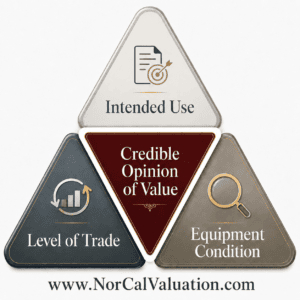
Three factors drive that movement in a construction and heavy equipment appraisal: the intended use of the report, the condition of the iron, and the level of trade where that iron would most likely change hands. Get those three settled up front and the number becomes defensible. Skip past them and you get a figure that falls apart the first time somebody with an opposing interest reads it closely.
One: Intended Use as the primary driver
Before I look at a single machine I need to know what the report is for. Not in a general sense. Specifically.
A dozer being valued for equitable distribution in a marital dissolution is a different assignment from the same dozer being valued as collateral for a revolving credit facility, which is different again from the value of that dozer intended to support a charitable contribution deduction or a property tax appeal. The physical asset is identical. The question is not.
Intended use helps frame the appraisal problem, including selection of the appropriate type and definition of value. The type and definition of value, together with the intended use, guide identification of the appropriate market or market level. California family law, for instance, carries its own definition of fair market value, drawn from case law rather than from the IRS or from a lender’s underwriting manual. A lender preparing for the possibility of default doesn’t much care what a patient seller could eventually get; they care what a receiver could realize in ninety days. Intended use directs an appraiser towards which market data will support a credible opinion of value.
So we never provide “just a value” on a fleet of construction equipment without understanding what the client plans to do with that value. Helping the client clarify the reason for the appraisal number is a critical part of our appraisal standard of care and one of the first steps in providing a useful number. An appraisal cannot be developed without an intended use and a report provided for one intended use and then repurposed for another is a liability for whoever relies on it … I’ve reviewed enough reports where exactly that happened to know how it ends. To learn a little more about the importance of intended use, take a look at Problem 2 in this earlier post about red flags in machinery & equipment appraisal reports.
Two: Used construction equipment markets matter
Understanding the appropriate market is the piece that gets skipped most often, and it’s the one that explains most of the spread between two valid appraisals of the same machine.
The used heavy equipment marketplace sorts into three broad sectors, which appraisers call levels of trade. Each has its own pricing behavior, its own data availability, and its own typical buyer.
Liquidation, aka auction. Goods sell to the highest bidder, as-is and where-is, with no warranty beyond title. Nothing about the transaction protects the buyer, so the buyer discounts accordingly. The upside for an appraiser is data. For most common categories of yellow iron, a large volume of completed auction results is published and searchable. That’s real transaction evidence, not asking prices, which makes auction the best-documented level of trade in this industry.
Private party. Goods move from one owner to another, usually at a negotiated price, also as-is and where-is with no expressed warranty. While the internet provides plenty of asking-price listings, confirmed sale prices are scarce. Private party pricing generally takes its cues from completed auction results and then adjusts upward, because the buyer gets to inspect the machine on the seller’s yard, talk to the operator who ran it, and walk away if something looks wrong.
Dealer. Dealers also sell at a negotiated price, typically landing somewhere near ninety percent of the listed number, and again with no expressed warranty. But dealers operate under the unique practical constraint of an assumed (or implied) warranty. A customer who has bought from the same dealership for two generations assumes an implied warranty whether or not one exists on paper. Dealers know it, and they protect their reputations by keeping only their better trade-ins on the lot. The rest goes to auction. That self-selection is the reason dealer inventory skews toward “Good” condition or better, and it’s a large part of why dealer pricing sits at the top of the range.
So when someone tells me an appraisal came in low, my first question isn’t about the machine. It’s about which market the appraiser concluded was relevant, and whether that choice followed from the intended use or was simply the market where data was easiest to find.
Three: Defined condition as a rating, not an adjective
“Good condition” means nothing until it’s defined. In my reports it means something specific: a machine that may or may not have been modified or repaired, and is capable of operating at or near its full designed and specified utilization.
Drop one step to “Fair” and the definition changes materially. Now the machine is running below its designed utilization because of age, condition, or the application it’s been worked in, and it will need general repairs and replacement of minor components in the foreseeable future to get back to specification. That’s not a small distinction on a piece of equipment with a six-figure replacement cost, and it’s not a judgment call I want to leave to the intended user’s imagination.
Condition labels are only useful when they’re defined rather than leaving them to the reader’s interpretation. Our reports include definitions based on the ASA Machinery & Technical Specialties suggested framework of New, Excellent, Very Good, Good, Fair, Poor, Repair/Refurbish, Salvage, and Scrap. One distinction worth making is that ASA treats Salvage and Scrap as condition ratings, not to be confused with salvage value and scrap value, which are valuation concepts unrelated to condition ratings; these valuation concepts describe the situations in which retired property, components, or material may have value. If you’re interested in the salvage and scrap value definitions, you can find them on the appraisal definitions page.
Inspection: Determining a condition rating
Different machine categories hide their value—or lack of value—in different places, so condition conclusions should be supported by information gathered in the assignment; for many equipment assignments, that includes a personal inspection. For non-inspection appraisals, appraisers will depend on accurate photos and interviews.
On a crawler dozer, the undercarriage is such a significant share of lifecycle cost that its state can reset the whole valuation regardless of how the paint looks. On a motor grader, the circle takes the brunt of the working force, and even modest wear on the circle teeth disrupts fine grading and gets expensive to fix. On a telescopic aerial lift, I’m checking swing box play at the turntable, where movement past about an inch and a half points to broken gears or turntable slack. On a wheel loader or excavator, I’m looking at pins and bushings for evidence of regular greasing, at the frame for cracks around the steering cylinder pin and bellcrank, and at every weld that a manufacturer didn’t put there.
Non-manufacturer welds on a boom or arm are worth pausing on. They tell you the component was broken and repaired, and a boom that broke once tends to break again. That’s a condition finding with a real dollar consequence, and it’s the kind of thing that never shows up on a depreciation schedule.
None of this is a technical evaluation by a certified mechanic, and my reports say so plainly. It’s a visual inspection by an appraiser who knows where these machines fail, combined with hour meter readings, maintenance history, and conversation with the people who run and maintain the equipment.
Integrating these three factors
Viewed through the lenses of these three factors, any spread of value stops looking arbitrary.
Take a fleet of well-maintained late-model machines owned by a contractor with no urgency to sell. If the intended use points to fair market value at the private party or dealer level, and the condition survey supports Good or better across the fleet, the conclusion lands near the top of the credible range.
Appraising the same fleet, but with a different intended use: a lender’s collateral position with a compressed disposition window: now I’m looking at auction evidence, applying an orderly liquidation premise, and the number drops even though not one bolt on those machines has changed.
That gap isn’t a disagreement about the equipment. It’s the honest consequence of asking two different questions.
California adds a wrinkle that appraisers outside the state routinely miss. The in-use off-road diesel fleet rules restrict where and whether older-tier engines can legally operate here, which means a machine that trades freely in Nevada or Arizona may carry meaningful economic obsolescence on this side of the line. Fleet emissions regulation has been reshaping values on the on-road side for years, and the off-road equivalent deserves the same attention in any California construction equipment appraisal.
The takeaway for attorneys, CPAs, and lenders
If you’re relying on an equipment appraisal, or defending one, three questions can quickly tell you whether it holds up.
- What was the stated intended use, and does the premise of value follow from it?
- Which level of trade did the appraiser conclude was relevant, and did they explain why?
- How was equipment condition determined, and is the rating scale defined somewhere in the report rather than left to inference?
A report that answers all three is doing its job. A report that skips them may still arrive at a reasonable number, but it can’t show you how, which is a problem in a deposition and a problem in an underwriting file. Most of the appraisal review work that comes to me involves reports that got the arithmetic right and the framework wrong.
If you have a construction equipment valuation coming up and you’re not sure which premise fits your situation, that conversation is worth having before the engagement letter is signed rather than after the report is delivered. Get in touch and we can work through it.
Jack Young, FASA, MRICS, CPA
NorCal Valuation Inc.