 My California agricultural equipment appraisals almost always involve sorting the fleet into three distinct categories: general-purpose machinery, crop-specific specialty equipment, and newer AI-enabled systems. I start the sorting process when we receive the asset list and refine it during the inspection process.
The first asset group is general-purpose agricultural equipment — the backbone of most agricultural operations: high-horsepower tractors, tillage tools, sprayers, and portable irrigation assets that can work across a wide range of crops. These machines trade in a deep, well-documented secondary market.
The second group is specialty machinery: orchard shakers and sweepers, tracked rice combines, vegetable bed shapers, and transplanters. These machines are built for one production system, which means the buyer pool is much narrower.
The third group is the newest and, from an appraisal standpoint, often the most interesting: AI-enhanced cultivators. These include autonomous laser weeders, vision-guided thinners, and retrofit autonomy kits that turn existing tractors into self-driving platforms.
Each group presents a different valuation challenge. Each responds differently to the commodity-price cycles that drive California agriculture. And each carries its own set of risks around functional obsolescence, economic obsolescence, and exposure period that an agricultural equipment appraisal needs to address head-on.
Let’s take a look at what’s involved in appraising agricultural equipment across these three equipment groups in California’s nut orchards, Sacramento Valley rice belt, and the Salinas Valley–Yuma–Imperial Valley vegetable corridor as we move through the 2026 production year.
General-Purpose Agricultural Equipment
Most California farms of meaningful scale run on a base of general-purpose machinery: tractors, sprayers, scrapers, tillage tools, service trucks, trailers, and pickups that can work across a variety of crops and regions.
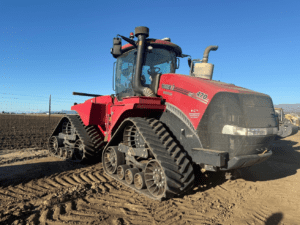
A Challenger MT800-series tracked tractor is a useful example. The same machine might pull a ripper through a Salinas Valley vegetable field, a disk in the Sacramento Valley rice ranch, or an orchard sprayer through a Central Valley walnut orchard. The equipment’s flexibility is why this class of machinery has a broader buyer pool and a deeper secondary market.
From an appraisal standpoint, these are usually the most straightforward assets to value. Major-brand tractors and implements trade often; auction results are usually available, and dealer asking prices are public.
But the analysis is not automatic. Hours, condition, configuration, emissions tier, guidance systems, and service history still matter. In this category, functional obsolescence is usually gradual rather than sudden: emissions transitions, GPS upgrades, telemetry systems, and other improvements can affect value without creating outright obsolescence.
California’s diesel-equipment rules also need to be considered. Advanced Clean Fleets rule and its implications are especially relevant for older Tier 2 and Tier 3 machines that may face a shorter operating window in the state. Even so, the comparable sales data is there; the market is liquid; and the appraisal methodology is well established.
Appropriately and accurately appraising general-purpose agricultural equipment is foundational for a defensible fleet valuation, but it doesn’t end there!
Crop-Specific Specialty Equipment
For California’s crop-specific specialty equipment, the public market and the buyer pools narrow. Each major California crop has a dedicated equipment ecosystem that does not transfer easily to other production systems.
Nut Orchard Equipment
California produces virtually all of the walnuts grown in the United States, with bearing acreage expanding from 218,000 acres in 2007 to a peak of 400,000 acres in 2022. Over that same broader expansion cycle, utilized in-shell production increased from 328,000 tons in 2007 to more than 800,000 tons in recent high-production years. For appraisers, this long expansion of dedicated walnut acreage underscores why crop-specific equipment, from mechanical harvesters and sweepers to hullers and dryers, represents a significant and distinct category of value on California tree nut operations.
A typical nut harvest begins with a mechanical tree shaker, manufactured by Flory, Weiss-McNair, Exact, or another specialty manufacturer concentrated in California’s Central Valley. After shaking, a sweeper pushes the dropped nuts into windrows, followed by a self-propelled or pull-type harvester that picks the nuts off the ground while separating them from leaf and stick debris. Nut carts pulled by tractors transfer the harvested crop to elevators that load it into trailers staged at the orchard edge. Around that core sequence sit orchard sprayers, mowers and shredders for floor management, ATV-mounted tools, and the smaller tractors specifically configured for narrow orchard rows.
The valuation challenge here is straightforward in concept and surprisingly subtle in execution. The sales-comparison approach works reasonably well for the most common units since sale data exists on used Flory shakers and Weiss-McNair harvesters of various ages and configurations. But the buyer pool is narrow: a used orchard shaker is most valuable to another almond, walnut, pistachio, or prune grower, and the geographic concentration of California orchards means the relevant market is meaningfully tied to in-state demand.
When commodity prices are weak and growers are deferring capital expenditure, the secondary market for orchard-specific equipment compresses noticeably. When prices recover, as they have for both almonds and walnuts moving into 2026, the secondary market firms up, but with a real lag behind the underlying commodity move.
California walnuts
Interactive chart: hover over points for annual values; use the controls to show or hide each series.
Source: USDA NASS Quick Stats, California walnuts, English, annual bearing acres and utilized in-shell production. 2025 values appear in the uploaded Quick Stats export and may be revised.
Rice Field Equipment
California’s 2025/26 rice crop is forecast to be one of the state’s stronger recent harvests, with harvested area expanding from 44,000 acres to 526,000 and production climbing 16% to 45.8 million hundredweight, bucking a national decline driven largely by flooding and falling prices in Arkansas. For farm appraisers, the simultaneous rise in California’s season-average farm price to $21.00 per hundredweight reinforces the income-producing value of Sacramento Valley rice ground and the specialized irrigation and harvesting equipment that supports it.
Rice production runs on a distinctive mobile equipment fleet. Tracked rice combines (Case IH, John Deere, Claas Lexion configured with rubber tracks) are engineered to operate on the soft, rutted ground that flooded rice culture leaves behind, and they don’t readily cross-purpose to other crops. Laser-leveled fields require GPS-guided tractors paired with laser scrapers. Levee construction and maintenance equipment, water management gates and check structures, grain carts and bankout wagons sized for rice, and the specialized aerial seeding ground-support equipment are included alongside the standard tractor fleet on a rice operation.
Highest & Best Use Analysis
The valuation question on a rice fleet often centers on how much going-concern premium is appropriate. A laser-leveled field with established water infrastructure, paired with a fleet that’s been operating on the same ranches for years, carries operational value beyond the sum of its parts. In drought years, that premium compresses; in years with full water allocations and recovering prices, it expands. The highest and best use analysis is the foundation of getting that conclusion right, and the analysis must be supported by an honest read of the local market — including the fact that the buyer pool for tracked rice combines and dedicated rice implements is narrow and largely confined to the Sacramento Valley.
There is also a notable shift at the margins of the rice belt: measurable acreage is converting to rice in the Sacramento-San Joaquin Delta on subsiding peat-soil islands. That conversion requires GPS-leveled land and dedicated water infrastructure, which means fresh capital deployment in equipment that wasn’t on those parcels five years ago. A Delta operation that has recently transitioned crops carries a different equipment-age profile than a long-running Sacramento Valley rice ranch, and the appraisal needs to reflect it.
Vegetable Production Equipment
The Salinas Valley and Monterey County are perhaps the most equipment-intensive vegetable production region in North America. In 2024, Monterey County supplied approximately 61% of the nation’s leaf lettuce, 57% of celery, 56% of head lettuce, 48% of broccoli, 38% of spinach, and 30% of cauliflower. Agriculture contributes over $3.9 billion per year to Monterey County’s economic output, with a total estimated impact of over $11.7 billion on the local economy.
Salinas Valley / Monterey County
Interactive chart: hover over each bar for the reported national production share.
Source: Monterey County Farm Bureau, Facts, Figures & FAQs. Percentages represent Monterey County crops as a share of total U.S. pounds produced each year.
The specialty mobile equipment that serves this strong production system is distinctive. Bed shapers configured for 40-, 60-, or 80-inch beds work alongside power mulchers, listers, and pre-plant cultivators. Transplanters — including PlantTape systems that have seen rapid adoption across the valley — handle the high-volume, time-critical replanting cycle that defines two-crop-per-year vegetable production. Cultivators, automated thinners, weeders, and harvest aids round out the field-equipment layer. Most distinctive of all is the portable irrigation infrastructure: three-inch aluminum sprinkler pipe by the joint, mainline, risers, fittings, and hand-move valves. On a multi-ranch operation, the irrigation pipe inventory alone can run to tens of thousands of individual pieces, with replacement value reaching into the high seven figures.
Seasonal Geographic Migration of Assets
The same vegetable supply chain that runs through Salinas from April through October pivots south for the winter. Tracked tractors, bed shapers, transplanters, harvest aids, and field logistics equipment that operate in the Salinas Valley during the summer moves south on lowboy trailers in October to Yuma County, Arizona and California’s neighboring Imperial Valley, which produce more than 90% of the leafy greens consumed in the United States from November through March. The trailers take it all back north in April.
From an appraisal standpoint, this geographic migration matters: At any given valuation date for a vertically integrated leafy-greens fleet, the equipment is likely distributed across two production regions and two states The relevant market for such a fleet extends well beyond California; the buyer pool includes operators in the Salinas Valley, Yuma, Imperial Valley, Coachella, the Central Valley, and to some extent Mexico. Defining that market accurately, both for highest and best use analysis and for estimating a reasonable exposure period, is critical. Appraising a cross-regional agricultural production does not present the same valuation problem as a single-ranch fleet specify to one region.
FMV / OLV Spread
The going-concern premium on an assembled vegetable-farming fleet of meaningful scale is typically substantial. The spread between fair market value (going-concern premise) and orderly liquidation value commonly ranges from 25 to 30%, reflecting the procurement risk a buyer would otherwise face in trying to assemble equivalent productive capacity from the secondary market. That spread is one of the most important and most frequently misunderstood concepts in agricultural equipment valuation, and it’s one of the first things a competent appraisal review examines when an appraisal report fails to address it.
AI-Enhanced Cultivators: The New Frontier
The newest equipment showing up on California farms (and the hardest to value) are AI-enhanced cultivators that use cameras and machine learning to handle weeding and thinning work that was formerly done by hand.
The most visible example in the Salinas Valley is the Carbon Robotics LaserWeeder, which uses high-resolution cameras and an onboard AI model to distinguish crops from weeds in real time, then targets each weed with a CO2 laser pulse. The current generation processes roughly two acres per hour using 30 simultaneous lasers, and the company released its LaserWeeder G2 in February 2025 — a lighter, modular design ranging from 6.6 to 60 feet of working width, starting at 4,250 pounds. A 2024 Western Growers case study documented a Salinas-area organic baby leaf operation reducing hand-weeding labor cost by roughly 40%, and the technology has been adopted by Salinas Valley operators including Triangle Farms, Braga Fresh, and Taylor Farms.
Carbon Robotics also released its Autonomous Tractor Kit in March 2025, a retrofit autonomy package that converts existing row tractors into self-driving platforms. Other manufacturers, from John Deere (with the See & Spray system that targets herbicide application based on real-time computer vision) to mechanical-blade competitors and emerging robotic harvest-aid platforms, are pushing similar technology stacks into commercial deployment.
For the appraiser, AI-enhanced cultivators raise three valuation issues that don’t show up in the same way on conventional equipment.
Technological Functional Obsolescence
The first is rapid technological obsolescence. The pace of generation-over-generation improvement in AI cultivation hardware is high — Carbon Robotics released a substantially improved second-generation LaserWeeder roughly three years after the first commercial unit. A used first-generation unit competing against a faster, lighter, more capable second-generation model carries genuine functional obsolescence even if it’s mechanically sound. Appraisers need to be careful not to anchor too tightly on original cost when the underlying technology is moving this fast.
Limited Secondary Market
The second is the narrow secondary market. While more than 200 LaserWeeders have been deployed and the unit count is growing, this is still a thin used-equipment market. Public auction comparables are rare. Dealer trade-ins are concentrated and not widely published. Sales-comparison analysis is constrained, which means the cost approach (less depreciation and obsolescence) and the income approach (capitalization of labor savings) often carry more weight than they would for a comparable John Deere tractor. Each of those approaches has its own data-quality challenges with this equipment class.
Ongoing Software & Service
The third is the increasing importance of software, subscriptions, and service contracts as components of total system value. AI-enhanced equipment is rarely a stand-alone hardware purchase. There is typically a software-subscription layer, a remote operations center, an OEM service contract, and an ongoing data-and-model-update relationship that materially affects the equipment’s productive utility. An appraisal of a LaserWeeder or an autonomous tractor kit that ignores the software-and-service stack risks producing a value conclusion that doesn’t reflect what a market participant would actually pay for the asset on a stand-alone basis. This is functionally similar to issues we’ve long dealt with on specialty processing equipment with proprietary control systems, but the pace of change is faster and the dependency is deeper.
Equipment Appraisal Considerations
For now, the AI cultivator class sits at the leading edge of California row-crop production, concentrated in high-value vegetable and specialty crops where labor costs are highest. As adoption broadens and a real used-equipment market develops, valuation practice will catch up. In the meantime, careful work and a clear-eyed read of the technology’s trajectory matters more than usual.
Calculating Where Asset Value Lives
Across these three main equipment categories — general-purpose iron, crop-specific specialty equipment, and AI-enhanced cultivators — equipment values are almost never evenly distributed across the asset list. On a typical multi-ranch farming operation, it is not uncommon for less than 20% of the line items to account for more than 80% of the total fleet value. A handful of high-horsepower tracked tractors, a few self-propelled harvesters, and a portable irrigation system can easily eclipse the combined value of dozens of smaller implements, hand tools, ATVs, and miscellaneous field equipment.
That observation drives how I structure the appraisal work. Before I commit to deep inspection, market research, and detailed sales-comparison analysis on individual assets, I run a mechanical first-pass cost approach across the entire inventory — replacement cost less straightforward depreciation, applied uniformly, without the obsolescence adjustments that come later. The output of that pass is not a value conclusion. It’s a value map. It tells me which assets carry the bulk of the value and therefore deserve the bulk of my time.
From there, high-value items get the full treatment: detailed inspection, equipment-by-equipment market research, sales-comparison work where defensible comps exist, careful functional and economic obsolescence analysis, and a complete market exposure period read. The lower-value items get a competent but more efficient treatment — typically anchored in the cost approach with appropriate adjustments and grouped where reasonable. The result is a fleet appraisal where the depth of analysis is proportional to the value at stake, which is what a defensible opinion of value on a large, mixed agricultural fleet actually requires.
This approach matters more, not less, on the kind of mixed fleet described in this article. A single Challenger MT800-series tracked tractor or a late-model self-propelled nut harvester can carry more value than the next thirty line items combined. Spending equal time on each item is not thoroughness; it’s misallocated effort. Identifying where the value is concentrated — early, mechanically — supports informed deeper focus on the high-value items within a realistic appraisal timeline and budget.
Credible Equipment Appraisals
A few common threads run across all three categories of mobile farm equipment.
The buyer pool widens or narrows depending on which category the equipment falls into: there’s a broad and deep market for general-purpose iron, narrower for crop-specific specialty equipment, narrowest of all for the current generation of AI-enhanced cultivators. The relevant market analysis must reflect that, and the exposure period should follow accordingly. A general-purpose tractor moves in 60 to 90 days; a specialty rice combine might take 6 to 12 months; an assembled multi-ranch row crop fleet under fair market value conditions reasonably takes 12 to 24 months.
Commodity prices drive equipment values through economic obsolescence, with a lag, and the lag is longer for more specialized equipment. When almond and walnut prices recover, the market for general-purpose orchard tractors firms first, the market for orchard-specific shakers and harvesters firms second, and the market for the most specialized installed equipment lags further still.
Going-concern premium is real on assembled, working fleets, and it must be defended. An appraisal that values a multi-ranch vegetable operation’s equipment as a piecemeal sum of auction comparables — without addressing the assembled-use premium — is incomplete on its face.
Functional obsolescence develops differently for AI-enhanced cultivators than for conventional equipment. Generations move faster, software dependency is deeper, and the calculation of what a market participant would actually pay for a used unit is genuinely harder. This is an area where appraisal practice is still developing. Thoughtful work matters.
California agriculture in 2026 is a story of recovery, recalibration, and accelerating technological change. For the equipment appraiser, it’s a reminder that the iron in front of you sits somewhere on a spectrum — from broadly tradable, well-comped, general-purpose units to highly specialized, narrowly traded, fast-evolving cultivators that didn’t exist a decade ago.
Determining accurate and appropriate categorization for specific agricultural equipment on the specific date of value is what separates a defensible opinion of value from a number on a page.
Jack Young, FASA, MRICS, CPA
NorCal Valuation Inc.