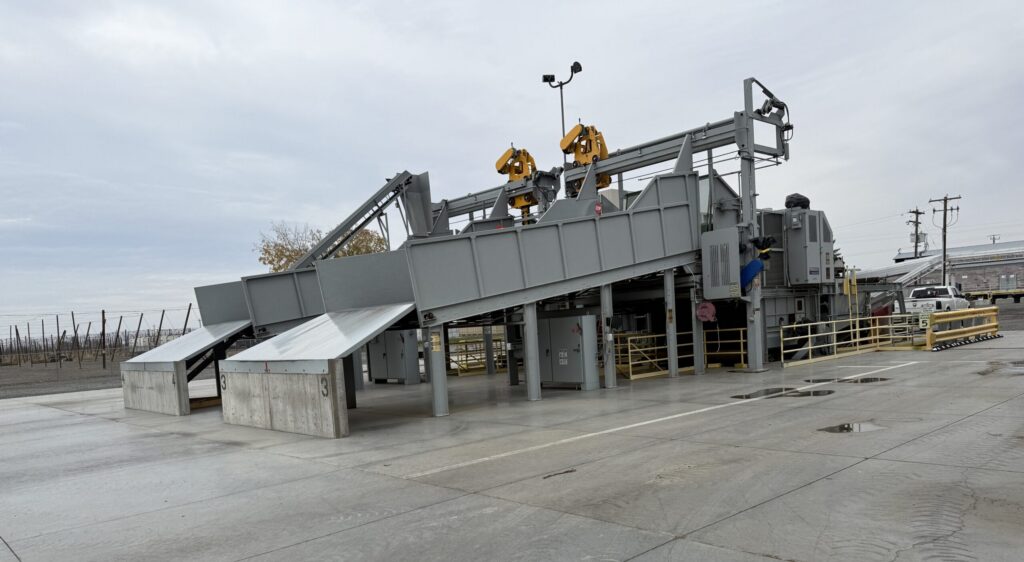
 Several years ago I appraised a single hop harvester in Idaho that had been destroyed in a fire. Last fall I had a much larger assignment: five hop processing locations with nine harvesters, along with the kilns, balers, and pelletizing equipment. Walking those plants and talking with the people who run them gave me a close look at an industry in the middle of a long correction. Growers were thinking hard about which yards to keep, which varieties were still under contract, and whether a kiln could earn something in the 11 months it sits idle. That correction shows up directly in what hop processing equipment is worth.
This post walks through how hops get from the field to a beverage, then looks at the market forces pressing on growers in 2026: a shrinking beer market, a craft segment that is closing more breweries than it opens, and a hemp sector facing a new federal definition. I close with what these conditions mean when someone needs a defensible agricultural equipment appraisal of a hop operation.
A Small Crop with an Outsized Infrastructure
Hops are the dried cones of the female Humulus lupulus plant. Brewers use them for bitterness, aroma, and the antimicrobial stability that lets beer keep. By tonnage it is a small crop, but it is concentrated in very few places. The United States and Germany together grow most of the world’s hops, and within the U.S. the Pacific Northwest grows essentially all of it, with Washington’s Yakima Valley responsible for roughly three-quarters of national acreage.
That concentration matters for valuation. A hop picking line or a twelve-bay kiln is not equipment that a buyer in Iowa is shopping for. The market for it is a few hundred growers, most of whom farm within a short drive of one another.
How Hops Are Grown
Hops are a perennial grown from rhizomes, and a planted yard can produce for many years. The defining feature of a hop yard is the trellis: wooden or steel poles carrying a grid of high wires, typically around 18 feet off the ground. Each spring crews hang coir or string from the top wire down to each hill, and workers hand-train two or three new shoots, called bines, clockwise up each string. The bines climb fast, reaching the top wire by midsummer.
Through the growing season the grower manages drip irrigation, fertility, and a long list of pests and diseases. Powdery mildew, downy mildew, and spider mites are the perennial worries in the Northwest. As the bines reach the wire they flower, and the female flowers develop into the papery cones that hold the lupulin glands. Those glands carry the alpha acids, beta acids, and essential oils that brewers pay for.
One feature of hops that growers value is flexibility. A newly planted yard produces a crop in its first or second year, so a grower can move acreage from a variety that has lost favor to one that is under contract without waiting years for a return. That flexibility is part of why acreage can swing as quickly as it has since 2021.
Harvest: Cutting, Picking, and Cleaning
Harvest runs from mid-August into September, variety by variety, as each one reaches the right dry matter, aroma, and cone feel. The window for each variety is short, and the processing plant runs around the clock for roughly a month.
In the yard, a cutter or top-cutting machine severs the bines at the top wire and near the ground, and the vines drop into a trailer or truck for the haul to the picking facility. How the vines get into the picker depends on which of the two main harvester designs the grower runs. I cover those in the next section.
The picking front end strips cones off the bine with rows of rotating wire fingers. What comes off is a mix of cones, leaves, stem pieces, and debris, so the back end of the line cleans it. Inclined belts, screens, shakers, and air separation sort the cones from the trash. The waste stream (vines and leaf) is conveyed out and usually returned to the field as compost. The cleaned “green” hops, still at roughly 75 to 80 percent moisture, are conveyed straight to the kilns.
Vertical vs. Horizontal Hop Harvesters: Cost and Efficiency
Valuing nine harvesters last fall gave me a side-by-side look at both main designs in operation. A hop “harvester” in this sense is not a machine that drives through the field. It is a stationary processing line in its own building, made up of a picking front end, a cleaning back end, and the conveyors, catwalks, and controls that tie them together.
Vertical hanger harvesters
The vertical design has been the industry standard for generations, and Dauenhauer Manufacturing is the long-established builder. Trucks pull up alongside the picking building, and workers hook the butt end of each bine onto an overhead chain conveyor. The chain carries the hanging vines through the picking fingers, and the stripped vines exit at the far end. The cleaning back end is built as part of the same integrated system.
A new Dauenhauer line, configured with its conveyors and catwalks, costs roughly $1.5 million and is typically sized to handle about 500 acres of hops in a season. Manufacturers estimate a service life of around 60 years, which is believable when you see how many older units are still picking every August.
The weakness of the vertical design is labor. Every bine has to be lifted and hung by hand, so the line needs a crew at the hanging station for every shift of a harvest that runs around the clock. Finding that crew, housing it, and paying it has become harder and more expensive each year.
Horizontal front-end harvesters
Horizontal systems are the newer approach, with Perrault Manufacturing building the front end. Instead of hanging vines one at a time, a forklift or telehandler pushes whole loads onto a horizontal feed bed, which meters them into the picking section. The back-end cleaning equipment is usually supplied separately, commonly by Kollmar, the same company that builds many of the region’s hop kilns.
The combined cost of a horizontal front end and its back end is roughly $5.5 million, more than three times the price of a vertical line. In exchange, a horizontal system can handle roughly 750 acres and runs with far fewer workers, since the hand-hanging crew goes away. Its estimated service life is similar, at about 60 years.
Comparing the two
On capital cost per acre of capacity, the vertical line is the clear winner, at roughly $3,000 per acre against something over $7,000 per acre for a horizontal system. On labor, the horizontal line wins just as clearly. Which design is more economical depends on how many acres a grower runs, what labor costs and availability look like, and how many days a year the line actually operates.
That last factor is the one people tend to underweight. A harvester earns its keep over roughly 30 days a year. Labor savings that would quickly justify a premium machine in a plant running year-round accumulate much more slowly over a single month of harvest. That is why growers are still buying both designs new, and why I would not assume one design makes the other obsolete. Among the nine harvesters I valued last fall, both types were working, and both were doing the job they were bought to do.
Drying, Cooling, and Baling
Green hops spoil within hours, so the kiln is the bottleneck of the whole operation. A typical Northwest hop kiln is a large building with multiple drying floors or bays. Hops are spread in a deep bed on a slotted floor, and burners (usually natural gas) push heated air up through the bed. Drying temperatures are kept moderate to protect the volatile oils, and a bed takes most of a working shift to dry. The goal is to bring the cones down to a stable storage moisture of about 8 to 10 percent by weight.
Once dry, the hops are moved to a cooling or conditioning room, where they rest so moisture evens out between the brittle outer bracts and the stem in the center of each cone. Hops that go straight from kiln to baler tend to shatter, and bales of uneven moisture can heat in storage.
Conditioned hops are then pressed into bales. The U.S. standard bale is about 200 pounds, wrapped in breathable fabric and roughly 56 by 26 by 16 inches. For years the industry workhorse has been the vertical baler, which needs a small crew to fill, press, and hand-stitch each cover. Newer automated horizontal balers can be run by one person and handle most of the bale closing on their own. Bales go into cold storage until they are sold whole-cone or sent for pelletizing.
Processing Into Pellets
Most hops today reach brewers as pellets rather than whole cones. Pellets take up a fraction of the space, store better, and dose more consistently. The standard product is the T-90 pellet, so named because roughly 90 percent of the original baled weight ends up in the pellet. The process runs like this:
- Bales are broken and blended, often across lots, to hit a target alpha acid range.
- The hops are dried slightly further if needed and milled to a fine powder in a hammer mill.
- The powder is fed through a pellet mill, where it is forced through a ring or flat die.
- Pellets are cooled quickly to limit heat damage to the oils.
- The pellets are packed in foil, oxygen-barrier bags, flushed with nitrogen or vacuum-sealed, and moved to cold storage.
Some processors go further, sieving the powder to concentrate the lupulin into T-45 or other “enriched” pellets, or making cryogenically separated lupulin powders and CO2 extracts. Those products are a growing share of what large brewers buy, and each one sits on its own specialized line of equipment.
Market Conditions in 2026
A long correction after the craft-era peak
Between roughly 2015 and 2021, acreage climbed on demand from craft brewers who were using proprietary aroma varieties like Citra and Mosaic at very high hopping rates. U.S. acreage peaked in 2021. Since then beer volumes have softened and brewers have worked through contracted inventory, and the industry has been shrinking back toward balance. The Brewers Association puts planted acreage down nearly 31 percent from that 2021 peak.
The 2026 numbers suggest the cutting may be leveling off in the U.S. According to USDA’s June 2026 Crop Production report, U.S. acreage strung for harvest is essentially flat at 41,642 acres versus 41,654 in 2025. Underneath that flat total, Washington dropped about 3 percent while Idaho rose almost 16 percent. Variety mix keeps shifting too. In Washington, Columbus/Tomahawk/Zeus (CTZ) acreage fell by close to a quarter while Citra grew.
Inventories are finally coming down. USDA’s September 1 stocks report shows 105 million pounds in grower, dealer, and brewer hands, 9 percent lower than a year earlier. The March 2026 figure was the lowest since 2018, the fourth straight annual decline.
Globally the picture is still one of surplus. The BarthHaas Report 2025/2026 estimates an hops surplus of roughly 1,200 metric tons from the 2025 crop and expects about 1,000 metric tons of surplus in the current supply balance, even after world acreage fell another 5.5 percent. As Inside.beer reported, uncontracted hops in Germany have sold for as little as one euro per kilogram, well below the cost of growing them. Spot prices for many aroma varieties in the U.S. remain below breakeven, and growers without forward contracts are carrying the most risk.
The adult beverage market is drinking fewer hops
Hop demand follows beer, and beer is not growing. BarthHaas reports that global beer production fell 0.7 percent in 2025 while hop demand fell nearly 3 percent. The gap comes from lower hopping rates and style preferences drifting away from heavily hopped IPAs toward lagers and lighter beers.
In the U.S., the shift is sharper. The Beer Institute reported taxable beer removals down about 5 percent through October 2025, and consumers continue to spread their spending across spirits-based ready-to-drink cocktails, wine, non-alcoholic options, and, in many states, hemp-derived THC beverages. Younger drinkers are drinking less alcohol, period. For a hop grower, every one of those substitutions is a lost pound of demand.
Micro-brewing: more closures than openings
Craft breweries were the engine of the last expansion, and they remain the most hop-intensive buyers per barrel. That makes their struggles especially important. Brewers Association data show 434 closures against 268 openings in 2025, the second straight year closures outpaced openings, with craft volume down about 5 percent at midyear. The breweries that remain are generally buying more carefully, contracting for shorter terms, and leaning on fewer flagship varieties.
There are bright spots. Non-alcoholic beer still needs hops, often in generous amounts to replace the body and flavor that alcohol provides. Sparkling hop water, which is little more than carbonated water and hops, has become a steady niche. Neither one is large enough to replace lost IPA volume, but both use the same pellets and extracts growers already make.
Hemp, cannabis, and a second use for the kiln
A hop kiln is, at bottom, a large forced-air dryer that sits idle for eleven months of the year. During the hemp boom that followed the 2018 Farm Bill, growers in Oregon and Washington put hop kilns, cooling rooms, and conveyors to work drying hemp, and some hop properties have since been leased outright to hemp operators. This isn’t secondhand for me. I have personally seen hop kilns drying hemp grown for CBD, using the same floors, burners, and fans that dry hops in August. The fit is not perfect. Hemp flower is more sensitive to heat than hop cones and is usually dried at lower temperatures and more slowly, and hemp harvest overlaps the tail end of hop harvest, so a grower running both crops through one kiln has a scheduling problem. Still, for a grower who has pulled acreage and has a kiln with spare capacity, drying hemp on a custom basis has been a real source of revenue.
Licensed marijuana is a different matter. State-licensed cannabis production must happen on licensed premises under state tracking rules, so a conventional hop farm generally cannot dry marijuana for a licensed producer the way it can dry hemp.
The bigger issue for 2026 is federal law. Congress narrowed the definition of hemp in November 2025 to cap total THC, including THCA, at 0.3 percent on a dry-weight basis, and to limit finished hemp-derived products to 0.4 milligrams of total THC per container. The change was originally set for November 12, 2026, and a September 2026 stopgap pushed most of it to December 11, 2026, according to the Hemp Law Group. Bills to delay it further, repeal it, or replace it with a regulated framework for hemp beverages are pending but have not moved. If the new definition takes effect as written, much of the smokable hemp flower and intoxicating hemp beverage market goes away, and with it a large part of the demand for custom hemp drying. A grower or lender counting on hemp drying income should treat that income as uncertain until Congress settles the question.
What This Means for Hop Equipment Value
In valuing hop picking, kiln, baling, and pelletizing equipment, I found the same handful of issues driving value from one location to the next.
The equipment is special purpose and tied to its site. Picking lines, kilns, and conveyor systems are engineered to fit a specific building and yard layout. A large share of their installed cost is foundations, electrical work, millwrighting, and engineering, none of which moves with the machine. That is why there is often a wide gap between fair market value in continued use, which assumes the plant keeps operating where it sits, and orderly liquidation value, which assumes it has to be sold. Lenders and investors need to understand which premise they are relying on, and I wrote more about choosing the right premise in Valuation Terms: Clarifying Purpose and Intended Use.
Short seasons mean long physical lives. Outside the pellet mill, most hop processing equipment runs about a month a year and gets cleaned and maintained in the off-season. Manufacturers estimate very long service lives for harvesters, and a well-kept picker from the 1980s can still be in the field. Age alone tells you less here than it does for most food processing equipment.
Shrinking acreage creates excess capacity. When a grower has pulled yards but still owns picking and drying capacity sized for peak acreage, the excess capacity is a real cost that a buyer would not pay for. I measure that with a cost-to-capacity analysis comparing installed capacity against current and projected acreage. In today’s market, that adjustment is common.
Labor-saving technology raises the obsolescence question. Horizontal front ends and automated balers cut labor sharply, which invites the argument that vertical harvesters and vertical balers suffer from functional obsolescence in the form of excess operating cost. As discussed above, the higher capital cost of a horizontal line may or may not be recovered through labor savings over a 30-day season, and growers keep buying both designs new. In my recent work I did not apply an excess operating cost penalty to vertical harvesters for that reason. I look at the evidence each time rather than assuming a penalty in either direction.
External obsolescence comes from the market, not the machine. When prices sit at or below breakeven, the income the equipment can support may fall short of its depreciated replacement cost. That is a business valuation question, and it should be addressed explicitly in the scope of work rather than ignored.
Alternative use can support value, carefully. A kiln that can dry hemp has a use beyond hops, which can help in a liquidation scenario. Given the federal hemp definition change, I would not lean heavily on that alternative use without current market evidence.
When a Hop Equipment Appraisal Makes Sense
A hop equipment appraisal is typically needed by lenders reviewing an agricultural loan portfolio, investors or private credit funds doing due diligence, attorneys handling a partnership dispute or estate, and CPAs who need a defensible number for a tax or financial reporting purpose. In a market this unsettled, an appraisal that explains how the cost approach, market evidence, and obsolescence were handled is worth more than one that simply reports a number. If you are reviewing someone else’s report on a hop or other ag processing facility, our appraisal review services can help you test whether its conclusions hold up.
If you are financing, buying, selling, or litigating over a hop farm, picking line, kiln, or pellet plant, I would be glad to talk through what kind of valuation fits your situation. You can reach me through our equipment appraisal services page.
Jack Young, FASA, MRICS, CPA
NorCal Valuation Inc.