 Why Don’t California Trailer Values Match the National Price Guides? Because a large share of the trailers working in this state were built for California crops, by small California manufacturers, and they never show up in national guide data at all.
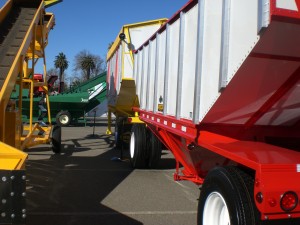
That’s the short answer, and it’s the single most useful thing I can tell an attorney, a CPA, or a lender who is looking at a trailer fleet valuation and wondering why the numbers don’t line up with what they found online. The published truck and trailer guides do a competent job on dry vans, reefers, and standard flatbeds, because those assets trade in volume nationally and the data supports it. But walk through a yard in the San Joaquin Valley in August and a good portion of what you see isn’t in any guide. It’s a tomato chassis, a grape gondola, a high rack hopper, or a custom side dump built by a welding shop two counties over for one grower’s operation.
Those assets still have value. Often substantial value. But establishing it takes a different kind of market research, and the trailer type itself is where that research starts.
California Grows Different Crops, So California Runs Different Trailers
The Central Valley produces over 400 commodities and accounts for a large share of the country’s fruits, nuts, and vegetables. Each of those commodities moves from field to processing facility in equipment configured for it, and the configurations don’t transfer well. A trailer designed to haul processing tomatoes isn’t useful for hauling grain, and neither one is much use for moving wine grapes.
The result is a regional equipment population that has developed largely on its own. Manufacturers serving this market tend to be smaller operations with direct relationships to the haulers they build for. Larger national firms haven’t penetrated this part of the market in any meaningful way. When I’ve talked with auctioneers, dealers, and manufacturers of these trailer types, the consistent message is that there’s no surplus of this equipment sitting around. Very few of these trailers show up at local auctions relative to the number actually in circulation.
That scarcity is an appraisal problem before it’s anything else. It means the most visible market data, which is auction results, represents a small and unrepresentative slice of what’s actually out there.
The Trailer Types That Show Up in California Ag Fleets
Here’s a working tour of what I encounter, and what each type does to the analysis.
Flatbed Trailer Sets
The backbone of a lot of valley ag fleets is the flatbed set, typically running around 24 feet per trailer and pulled in pairs. On its own, a flatbed is a flatbed. What makes it a specialized asset is what gets mounted on it.
Flatbeds carry tomato tubs during processing tomato harvest. They carry grape gondolas in the fall. They carry garlic and onion boxes. Those attachments are frequently assigned to specific trailers and frequently listed as separate line items on the fixed asset schedule, which is where the valuation gets interesting. A flatbed with a tomato tub and a bare flatbed are not the same asset from a value standpoint, and the tubs and gondolas themselves carry value whether or not they’re mounted at the time of inspection.
Hopper Trailers, Straight and High Rack
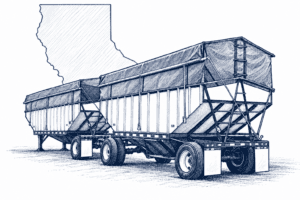
Hoppers move grain, row crops, and tree nuts, with the hopper bin permanently mounted to the frame. The distinction that matters is between a straight hopper and a high rack, which adds an extension on top of the straight hopper to increase volume. High racks are common for almonds, walnuts, and sunflower seed, where the load cubes out well before it weighs out.
You’d expect the high rack configuration to command a premium. In one recent assignment, the available market evidence simply didn’t isolate a measurable difference between straight and high rack units that were otherwise comparable, so I valued them at parity and said so in the report. That’s not a satisfying answer, but it’s the honest one. Inventing a premium the data doesn’t support is worse than reporting that the market didn’t distinguish.
Convertible Trailer Sets
Convertibles are a genuinely clever piece of equipment and a recurring valuation puzzle. A section of the bed lifts out and a hopper drops in, so the same trailer runs as a flatbed with tomato tubs during summer harvest and as a hopper for nuts or grain in the fall.
The appraisal question is whether the convertibility itself carries value. My general view is that it does, because it extends the trailer’s earning season and broadens the buyer pool, but it has to be supported rather than assumed. And it complicates the asset list, because a convertible fleet comes with an inventory of drop-in hoppers and bed inserts that live in the yard rather than on the trailer.
Tomato Chassis
In fleets serving the processing tomato market, chassis units can be the single largest category by unit count, running in both semi and pull configurations and in 96 inch and 102 inch widths. Those width and configuration distinctions are not cosmetic. They affect what the unit can do and who will buy it, and they need to be captured accurately on the asset list before any market research begins.
Custom and One-Off Configurations
Then there’s equipment that was designed by the operator, built by a local welding shop, and exists nowhere else. I’ve appraised custom side dump trailers with fiberglass sides, built light to maximize payload, used for hauling carrots, onions, and garlic. Nothing like them had ever been sold on the used market, so there was no market data to analyze.
When there’s genuinely no active market for an asset type, the sales comparison approach can’t do the work, and the cost approach becomes the appropriate methodology. That’s not a workaround. It’s the correct answer to a specific market condition, and a report that quietly forces a sales comparison conclusion onto an asset with no comparable sales is a report with a problem in it.
The Conventional Equipment
Most ag fleets also carry a complement of more standard assets: dry vans in 45 and 53 foot configurations, curtain vans, produce trailers in shorter lengths, container chassis, water and fertilizer tankers, pneumatic trailers, converter dollies, and yard spotter trucks. These are the units where national market data actually helps, and they anchor the analysis. But they’re usually the minority of the fleet by value.
Three Things About Trailers That Change the Number
They Trade in Sets
Ag trailers in this market frequently operate and sell as two-unit sets, a semi-trailer plus a pull trailer, and the available market evidence often prices the set rather than the individual units. When the asset list or the collateral schedule requires unit-level values, that set price has to be allocated between the two, and the allocation isn’t fifty-fifty, because the one-axle semi and the two-axle pull aren’t equivalent assets.
Detachable Equipment Carries Its Own Value, and Some of It Doesn’t
Tubs, gondolas, boxes, and drop-in hoppers move between trailers and need to be inventoried separately. So do tarps, with a distinction that’s easy to miss: a mechanical rollover tarp adds value to a hopper, while a standard pull-back tarp generally doesn’t, even though both satisfy the same on-road requirement. That’s the kind of detail that only turns up in conversation with the people who run the equipment, which is one of several reasons inspection interviews matter more than they get credit for.
Reconditioning Resets the Clock
Some of the better-run fleets in this state strip ag trailers to the bare frame on a defined cycle, sandblast, repaint, and replace brake lines, brakes, and wiring. A twenty-year-old trailer coming out of that process can present as nearly new.
This has a direct consequence for how age gets treated. The basic design of a hopper, a flatbed, or a chassis hasn’t changed meaningfully in decades, so there’s often no real functional deficiency in an older unit relative to a new one. Combine that with a genuine reconditioning program, and chronological age becomes a poor proxy for value. I’ve concluded no functional obsolescence on fleets of trailers old enough that a purely age-based schedule would have written them down to nearly nothing.
The reverse is also true and shows up more often. When a package of trailers comes to market because a smaller operator is exiting, deferred maintenance is frequently embedded in it, and that’s usually why the pricing looks soft.
Where the Power Units Fit
Trailers don’t carry engines, which means the California emissions regulations that have reshaped the on-road fleet apply to the tractors and yard trucks, not to the trailers behind them. That distinction is worth keeping straight, because it can drive very different conclusions within a single fleet.
I’ve handled assignments where nearly the entire truck fleet was excluded from the appraisal because the units were approaching the point of being unable to operate legally in California, while the trailers they pulled held their value without difficulty. On yard trucks, emissions tier tends to be a primary value characteristic alongside hours and mechanical condition, with current-standard units commanding a premium over older equipment facing operating restrictions in California air districts.
My general conclusion on the regulatory question is that the market has already absorbed it. Local comparable sales for affected assets reflect the regulations, which means the work is selecting comparables from the affected market rather than applying a separate discount on top. I’ve written more about how fleet emissions rules interact with vehicle values if that’s the piece you’re after.
What to Ask When You’re Reviewing a California Trailer Appraisal
If a trailer fleet valuation crosses your desk, whether you’re underwriting against it, using it in a dissolution, or relying on it in an acquisition, a few questions will tell you quickly whether it was done by someone who knows this market:
- Does the report identify trailer types with enough specificity to matter, or does it just say “trailers”? A schedule that lists 300 units without distinguishing hoppers from chassis from flatbeds hasn’t done the work.
- Where did the comparable data come from, and does it reflect California? National guide values on a grape gondola should prompt a question.
- How were detachable tubs, gondolas, boxes, and tarps handled, and are they double counted or missed entirely?
- If any asset class had no market data, does the report say so and explain what it did instead?
- Was the level of trade selected to match the intended use, or selected because that’s where data was easiest to find?
Good quality trailers in this market are a rare occurrence and typically sell private party with no public record. That reality shapes everything downstream, and an appraisal that doesn’t acknowledge it is working from a market that doesn’t exist.
If you have a California agricultural or transportation fleet valuation coming up, or a report you’d like a second set of eyes on, get in touch and we can talk through it.
Jack Young, FASA, MRICS, CPA
NorCal Valuation Inc.